Before the Icebox: How People Kept Food for Later
Before the icebox, food preservation matched ingredients to local conditions. Learn how drying, salting, pickling and cooling shaped what people ate.
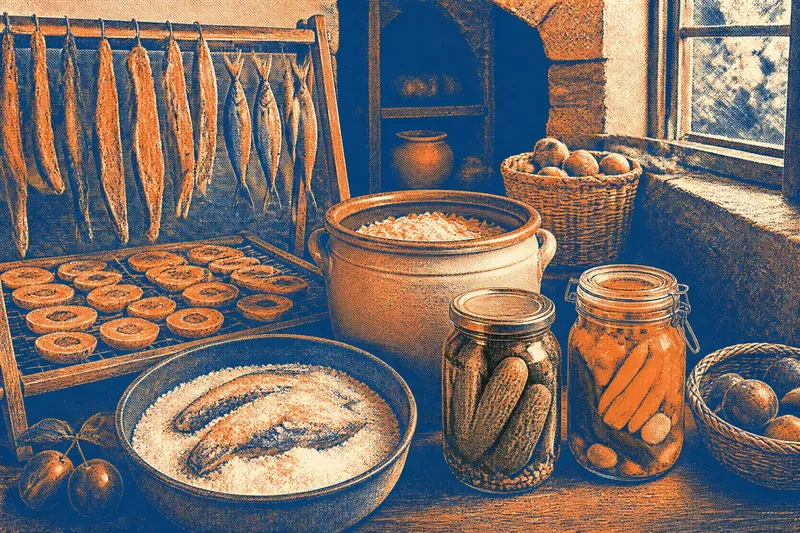
A common mistake in thinking about food preservation before the icebox is to picture one clever method replacing another. That misses the trade-offs: households worked with the ingredients, weather, fuel and storage they had, and preserving food often changed its flavour or texture. Practices varied by place and period, so there was no single routine shared by everyone.
Start with the ingredients
Food spoiled at different rates, and households had different supplies. In broad terms, a fishing community with access to salt might preserve some fish, while a household with a fruit harvest might dry or pickle part of it. Climate and storage mattered too: dry air could help with drying, while a cool cellar could keep some foods cooler than a warm kitchen.
Preservation changes the conditions around food so it remains usable longer. Drying removes moisture; salting creates a salty environment and draws moisture from food; pickling uses acid or fermentation; cooling slows spoilage. These are explanations of the principles, not safe recipes. For modern home preserving, use a current, tested recipe and follow its ingredients, method and storage directions.
Drying in suitable weather
Drying reduces the water in food, making it less hospitable to many spoilage organisms. Thin fruit slices, strips of meat and small fish can dry more readily than thick pieces. Depending on the place and season, people used sun, moving air, a warm hearth or a drying rack.
The change affected how food was eaten. Dried fruit was compact and often chewy, while dried fish could be carried away from the coast. Damp weather could hinder drying, and the finished food might taste more concentrated than fresh. Households had to weigh those changes against the space and conditions available.
Salting meat and fish
Salt can draw moisture from food and make its surroundings less favourable to many spoilage organisms. Historical accounts describe methods such as packing meat or fish in salt and keeping foods in brine, which is salt dissolved in water. The details differed across settings, and old descriptions should not be used as instructions for home preserving.
Salt changed the meal as well as the stored ingredient. A cook might soak or rinse a preserved piece before adding it to a dish, and its savouriness could influence the rest of the pot. Salt was also a resource to allocate: where it was difficult to obtain, a household might reserve it for foods that suited the method and later use.
Pickling by two routes
Pickling can mean preserving food in an acidic liquid such as vinegar, or fermenting it so naturally occurring microbes produce acidity. The two routes create different flavours. Vinegar pickles often taste sharply sour, while fermented foods can develop more complex, savoury notes.
People used the crops, seasonings and vessels available to them, including earthenware crocks in some settings. Today, use a reliable recipe intended for the particular food and container; cleanliness and the specified proportions and storage method matter. A modern glass jar is suitable only when the recipe is designed for that approach.
Cooling without an icebox
Cooling slows spoilage but does not stop it indefinitely. Before electric refrigeration, people in some places used cellars, larders, caves, wells or stored ice to find a cooler place for food. What worked depended on the local landscape, the household and the food being stored.
A cellar could stay cooler than a kitchen, while an icebox used stored ice to chill an enclosed space. Neither was available to every household, and a cellar did not provide the controlled cold of a modern refrigerator. Cooling could leave food closer to its fresh character than drying or salting, but depended on access to a consistently cool place.
Match method to kitchen
Imagine a household with a basket of ripe plums, a dry, breezy space and little salt. The family sets aside some plums to dry and keeps another portion in a cool cellar for nearer use. The dried fruit becomes chewy and concentrated, while the cellar-stored fruit stays closer to fresh for a time; the choice uses the available air and cool space without relying on scarce salt.
Preserving is like choosing a container for a journey: a paper bag suits one purpose, a lidded tin another. The useful historical question is not only how a food was kept, but what resources were at hand and which changes to the ingredient people accepted.
- Drying: Check whether the food can lose moisture and whether the air or hearth is suitable; if conditions are dry and workable, drying may fit, but if the weather is damp, consider another available method.
- Salting: Check whether salt is available and whether a salty flavour suits the later dish; if both fit, salting may be practical, but if salt is scarce or the flavour would clash, reserve it for another use.
- Vinegar pickling: Check whether the ingredient suits a sharp, acidic flavour and whether a suitable vessel is available; if both are true, this route may fit, but if not, choose another method suited to the food.
- Fermentation: Check whether the food and vessel suit a reliable fermentation method; if they do, follow a tested recipe, but if the method or storage directions are unclear, do not improvise.
- Cooling: Check whether a consistently cool place is accessible and suitable for the food; if it is, cooling may help for nearer use, but if the spot is warm or unreliable, choose another appropriate option.
- Later use: Check how the preserved ingredient will taste and behave in a meal; if its texture and flavour suit the dish, plan to use it there, but if they do not, set it aside for a preparation that can accommodate the change.
Questions about preservation?
Did every household use all four methods?
No. Climate, crops, trade, fuel, salt and storage space shaped what was possible, and practices varied by place and period. A method useful in one setting could be impractical in another.
Was a cellar the same as refrigeration?
No. A cellar might be cooler than a kitchen, but it did not provide the controlled conditions of a modern refrigerator. Different foods also respond differently to storage conditions.
Can an old recipe guide safe preserving now?
Not by itself. Historical accounts can explain past practices but may leave out details needed for safe home use. Choose a current, tested recipe for the specific food and method.
Why did preserved food taste different?
Each method changed the ingredient in a different way: drying concentrated flavour, salt added savouriness, pickling brought acidity, and cooling generally changed the food less. Those differences shaped the meals people made with preserved ingredients.
Read the kitchen behind it
Before the icebox, preserving food reflected a household’s surroundings: the harvest, the weather, the pantry and the materials available. Drying, salting, pickling and cooling each offered a different compromise between keeping food and changing it.
For anyone asking how people kept food before the icebox, the clearest answer is that households often combined methods rather than relying on one universal solution. Their choices turned seasonal ingredients into foods suited to another day, while leaving each with a distinct place in the kitchen.